RoboWorld Challenge 2026 · Track #3
SafeDrive-VLA
Towards Safety in Autonomous Driving
Language-guided driving that follows safe instructions and responds safely to instruction-scene conflicts.
- Benchmark
- CARLA-F / B2D-C
- Setting
- Closed-loop safety-aware driving
- Metrics
- NCR, speed error; DS, SR, infractions
Introduction
Participants develop vision-language-action models (VLAs) for safe navigation guided by natural-language instructions. Given onboard visual observations and an instruction, models generate driving trajectories or control actions that account for surrounding traffic conditions.
Models should follow safe instructions, including turns, lane changes, and target-speed requests. When an instruction conflicts with the traffic scene, models must respond appropriately by slowing down, waiting, or selecting a safe alternative.
Reference
SafeDriveVLA: Navigation-Conditioned World Model Dreaming for Conflict-Aware End-to-End Autonomous Driving
CoRL 2026
 GitHub
Registration
Register Your Team (Google Form)
Submission
Submission Portal (CodaBench Server)
Dataset & Evaluation Setting
Evaluation consists of 40 closed-loop simulation routes across two complementary test sets.
| Split / Test Set | Size | Details |
|---|---|---|
| CARLA-F | 20 routes | Safe instruction following |
| B2D-C | 20 routes | Conflicting instructions issued when hazards occur |
Training Data
Training uses the CARLA driving dataset that SimLingo (CVPR 2025) collected with PDM-Lite, a privileged rule-based expert. The dataset is released on Hugging Face as RenzKa/simlingo.
- Scale. 3,308,315 samples recorded at 4 fps, distributed as about 1.2 TB of compressed archives. Samples are not from unique routes, because the available CARLA route files are limited.
- Routes and scenarios. Routes come from Towns 1–10 and from the official CARLA Leaderboard 2.0 routes in Towns 12 and 13. All are short routes with one scenario (62.1%) or three scenarios (37.9%), driven under random weather. They cover 38 complex scenarios, including urban traffic, participants violating traffic rules, and high-speed highway driving.
- Language annotations. Commentary that explains driving decisions; instruction-following (“Dreamer”) data with multiple alternative instruction–action pairs per sample, each labeled with whether the instructed action is safe to execute and, if not, why; and VQA based on DriveLM.
- Use in the reference baseline. SafeDriveVLA uses the driving frames and measurements, the instruction-following data, and the scenario buckets for balanced sampling, and trains on a 20% subsample; it does not use the commentary or VQA annotations.
Evaluation
CARLA-F evaluates safe instruction following using per-instruction Navigation Compliance Rate (NCR) and target-speed error in m/s.
B2D-C evaluates safety-critical driving using Driving Score (DS), Success Rate (SR), and counts of collisions, traffic violations, and route departures. Results from the two test sets will be reported separately.
| Metric | Preferred Direction | Definition |
|---|---|---|
| CARLA-F: Navigation Compliance Rate (NCR) | Higher | Per-instruction navigation compliance. |
| CARLA-F: target-speed error (m/s) | Lower | Deviation from the instructed target speed. |
| B2D-C: Driving Score (DS) and Success Rate (SR) | Higher | Closed-loop driving performance and route success. |
| B2D-C: collisions, traffic violations, route departures | Lower | Counts of safety and route-following failures. |
Reference Baselines

SimLingo and SafeDriveVLA both generate driving actions from visual observations and language instructions. SafeDriveVLA additionally uses explicit driving-mode selection and world-model predictions to handle conflicts between instructions and the traffic scene.
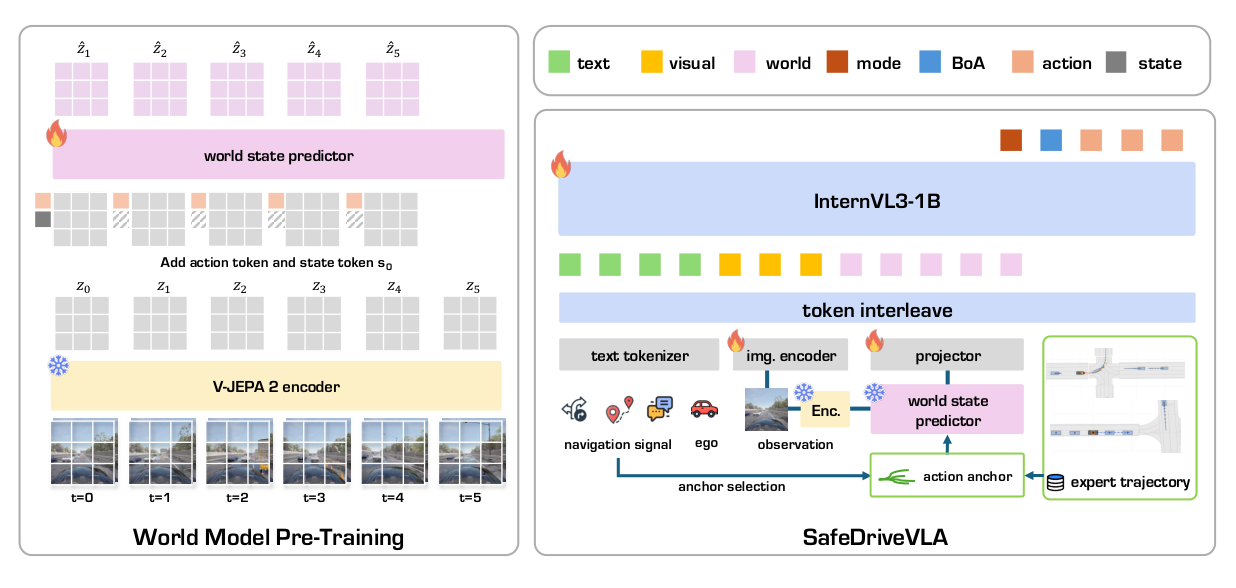
SafeDriveVLA decouples conflict reasoning from action generation:
- Driving mode. Every expert frame is relabeled with a discrete driving mode (strict, cautious, or fallback) that states whether the trajectory executes, cautiously follows, or overrides the navigation signal. The model emits this mode token before its actions, so conflict awareness is supervised directly.
- Navigation-conditioned world-model dreaming. A frozen latent world model, a V-JEPA 2 encoder with an action-conditioned predictor, rolls the scene forward under the action anchor of the instructed maneuver. The policy reads these predicted world tokens and can see whether the maneuver is feasible before it commits.
The SafeDriveVLA repository provides world-model pre-training, VLA training, and closed-loop evaluation code for CARLA-F and B2D-C, together with the benchmark route files and data-preparation instructions.
Reference benchmark results are shown below; these are baseline results reported in the SafeDriveVLA paper on the full benchmark routes, not competition submissions.
| Baseline | CARLA-F (NCR) | B2D-C (DS) |
|---|---|---|
| SimLingo | 52.4% | 72.8 |
| SafeDriveVLA | 82.7% | 67.3 |
The CARLA-F values are the average Navigation Compliance Rate (NCR), and the B2D-C values are the average Driving Score (DS). The two test sets measure different aspects of performance: (1) instruction following in safe scenarios and (2) awareness of unsafe instructions.
Track Organizer





Contact
For challenge questions, contact roboworld2026@gmail.com.